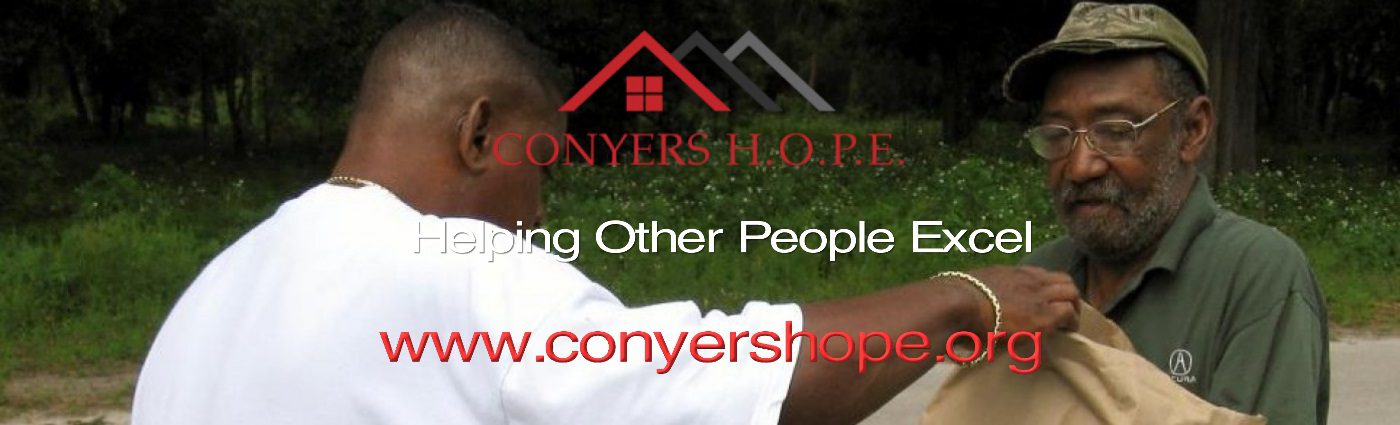
Weekly Outreach

Sometimes in life you don’t need a handout you need a hand up, someone or something that will assist you when you have exhausted every measure in your life, you have no idea how to begin again, or you have simply given up.We stand strong in supporting the local government and assisting in an open arms manner, we are open to one and all regardless of race, creed, color, or gender it is simply our mandate to love.

Conyers Hope is a community transformation endeavor that thrives off of volunteerism and community participation.

Conyers Hope was designed with the intent of being a resource to the community and enabling the community to thrive and create a unified front.

We feel that if there is one need in the community that is not being met it prevents the community from propelling forward in a team atmosphere, and it cripples the ability strengthen relationships.

The Art Of Listening

Listening is an art that requires work, self-discipline, and skill. The art of communication springs as much from knowing when to listen, and when to speak.

1.Make Eye Contact.
This first rule is very obvious but frequently forgotten. If you don’t look at the person while they’re speaking, you give them the impression that you don’t care what they say. In essence, it appears as though you don’t even care about them. Simple.

2. Don’t Interrupt.
Let the person speak uninterrupted. To master the art of listening you need to halt any good thoughts that come to mind and let the person say everything they need to say. Often times people simply need someone to talk to, not someone who will butt in and give their own thoughts and opinions. The goal is to shine the spotlight on them, not you.

3. Practice “Active Listening”.
The art of listening isn’t simply about staying quiet 100% of the time, it’s also about asking questions. These questions are for clarification, or for further explanation so that you can fully understand what the speaker is telling you. For instance, questions like these are brilliant: “Are you saying that _______”, “What I heard you say was ______”, “Did you mean that _______”.

4. Show You Understand.
Another great way to show that you understand what the person is telling you is to nod. You can also make noises that show you’re in tune with what the person is saying such as “yes”, “yeah”, “mhmm”, “okay”. This seems trivial, but it’s important to not behave like a zombie and demonstrate some interest and comprehension.

5. Listen Without Thinking.
In other words, listen without forming responses in your mind. Be wholehearted and listen to the entire message. It’s very tempting to fill the spaces, after all, our minds think around 800 words per minute, compared to 125-150 words we speak per minute. Don’t miss valuable information by letting your mind wander!

6. Listen Without Judgement.
To effectively master the art of listening it’s extremely important to withhold any negative evaluations or judgements. Make it your goal to be open minded 100% of the time. After all, who wants to open up to a narrow minded person? It also helps to be mindful of your “shut off” triggers, which are the specific words, looks, or situations that cause you to stop listening. This way, you can prevent yourself from shutting off in the future.

7. Listen To Non-Verbal Communication.
About 60 – 75% of our communication is non-verbal. That’s a lot! In order to know whether to encourage the speaker, to open yourself more, or to be more supportive in your approach, it’s essential to know what the person’s body is saying. Do they display signs of discomfort? Are they untrusting of you? Does their body language align with their words? To learn more about body language, try checking out some of Sol’s Body Language articles.

8. Create A Suitable Environment.
It can be really difficult to listen to another person when the TV is screaming, your phone is buzzing and there are thousands of cars passing by. When you remove all of these distractions and find a quiet place to sit down and listen, it’s much easier to listen empathetically with an open mind and whole heart. Also, when you indicate it would be good to “find a quiet place”, you put importance in the person and what they have to say. Once again, you show care and consideration.

9. Observe Other People.
If you’re really serious about mastering the art of listening, why not observe other people? One of the best ways to become a better listener is to observe the way people interact with each other, and all the irritating and rude things they do. Create an “annoying habit” checklist, and see if you do any. If you’re brave enough, you can even ask someone you trust about what they like and dislike about the way you interact with others in conversation.

(This information was taken from http://www.lonerwolf.com)

Men Mentoring Young Men.

As mentors enter into the mentoring relationship,
they need to develop an awareness of critical
consciousness. Developing critical consciousness
requires an understanding of the unique
challenges each child or young man faces, which
are specific to his culture and environment. The
development of this consciousness requires
an examination of race, ethnicity, class, and
gender issues.

Therefore we consider it a Privilege and Honor to network with organizations such as Boyz to Men of Honor, to foster these type of mentoring opportunities. There is a new, younger generation of brothers rising into the manhood ranks. Some of them coming from single-parent homes. Still others coming into to the spotlight of adulthood from some horrible experiences. Others are already out of college or university and making their way along the road of life, looking for a helping hand.

The Lord’s House coordinates this effort on 4th Friday Nights, but B2Mh does this every week. There are several volunteer opportunities available for you. if you are interested visit http://www.B2MH.ORG

Life Without A Home

Many of us look at the homeless in disgust, knowing that if they would just shake their addiction and apply themselves they could get a job and get back on their feet. Others of us look at the homeless and feel sorrow and sympathy wanting to help, but only able to throw a dollar their way.

But as believers in Jesus Christ, how are we supposed to react? Many believers think that if the homeless would just commit themselves to Jesus, then their lives would get straightened out and they could be normal participants in society. What many Christians don’t know is that at least a third of those who live on the street already have committed themselves to Jesus and are doing their best to live a Christian life. Yes, some are addicts, but not all. Many are mentally ill, but we cannot blame homelessness exclusively on mental illness, either.

How does Scripture tell us to react to these poor and outcast of society?

We are to show respect to the poor. James 2

We are to respond in love and compassion to everyone in need. Luke 10

We are to offer help, especially to believers. Galatians 6:10

We are to offer hospitality, clothing, shelter and food. Matthew 25:31-46

We are to offer fellowship and peace. Romans 12

Most of all, according to Scripture, we are to love. This doesn’t always mean giving money or food, although we shouldn’t be closed to that. But it does always mean being patient, being kind, not putting ourselves over the other person, but bearing other’s burdens and enduring with them. I Corinthians 13

Not A Hand Out, But A Hand Up.

Sometimes in life you don’t need a handout you need a hand up, someone or something that will assist you when you have exhausted every measure in your life, you have no idea how to begin again, or you have simply given up.We stand strong in supporting the local government and assisting in an open arms manner, we are open to one and all regardless of race, creed, color, or gender it is simply our mandate to love.

Conyers Hope is a community transformation endeavor that thrives off of volunteerism and community participation.

Conyers Hope was designed with the intent of being a resource to the community and enabling the community to thrive and create a unified front.

We feel that if there is one need in the community that is not being met it prevents the community from propelling forward in a team atmosphere, and it cripples the ability strengthen relationships.